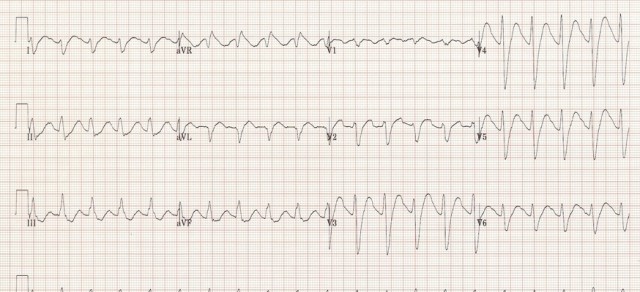
This was all brand new to me. I was reviewing a syncope patient left over from the night shift before. The hand over was: recent change in anti-hypertensives, now feeling weak and dizzy about 1 week. Syncopal episode at dinner table last night.
She’d been in the department overnight, got some fluids, bloods and an ECG. The ECG was said to be normal.
I went and chatted to the patient and yes indeed it did sound all very like postural hypotension. I went back and looked at the ECG and did my usual syncope ECG review looking for the following:
- Brugada
- HOCM
- WPW
- intervals – QT and PR
And there it was – a nice big QTc of 550ms staring at me.
I still suspect that postural hypotension was the main cause of her symptoms but it would be a tad on the risky side to call it that in the context of a long QT. K+ and Mg++ were on the low side (3.5 and 0.6) so she got a bit of both and admitted for ECG monitoring.
The interesting bit came in the discussio with admitting doctor who was (for once) interested, enthusiastic and asked about the standing test for Long QT. This was all news to me but effcetively people with a long QT syndrome (LQTS) have an abnormal response in QTc with standing.
In healthy people on standing the heart rate goes up with corresponing shortening of the QT interval. Due to the fact that heart rate goes up more than the QT comes down, the QTc actually goes up slightly,
In LQTS the QTc often goes up substantially.
This paper addresses this concept and while it’s in now waty perfect (ie it examined it in people known to have LQTS which undermines its use as a diagnostic test in undiagnosed QT problems) it suggests that in healthy people an increase in QTc on standing of about 10-15ms is allowed but in LTQS is likely to be in the range of 90-100 ms.
Viskin, Sami, Pieter G Postema, Zahurul A Bhuiyan, Raphael Rosso, Jonathan M Kalman, Jitendra K Vohra, Milton E Guevara-Valdivia, et al. “The Response of the QT Interval to the Brief Tachycardia Provoked by Standing: a Bedside Test for Diagnosing Long QT Syndrome..” Journal of the American College of Cardiology 55, no. 18: 1955–1961. doi:10.1016/j.jacc.2009.12.015. PMID 20116193
METHODS
- the normal response to standing after lying is an increase in HR. This would normally be accompanied by a shortedned QT. In LQTS this apparently isn’t the case
- The intervention was standing and recording QT changes.
- they did this on high risk LQTS (lots of features but no diagnosis as yet) and those who actually had it genetically documented. The controls were healthy relatives of those pts or volunteers (the vast majority)
- took them off Beta blockers for a day then lay them flat 10 mins and stood them up for 5 mins with telemetry.
- blinded investigator performed the measurement had a set part of the trace. Bazzett’s formula was the main one used.
- excluded the obviously normal and obviously prolonged
RESULTS
- 68 LQTS; 82 controls
- the baseline QTs were 380 v 450 – not diagnositcially different but borderline
- the QT went down in all the normals but less than the RR interval therefore the QTc goes up slightly.
- the QT of those with LQTS didn’t change at all. In some it went up. Or put another way the QTc of the control group went up 13ms while the LQTS patients the QTc went up 89ms
Not something I’m going to be doing every day, but it’s a fairly nice, bedside test that we can apply in the ED.


Links for the social media thingies…